
Neptunes Moon Mystery: Clay Minerals Reveal Violent Cosmic History
TL;DR

Neptunes inner moons and rings formed from the violent collision and destruction of ancient icy moons when Neptune captured Triton from the Kuiper Belt. This cataclysmic event shattered the original moon system, and debris eventually reformed into current inner moons and rings.

Neptune's Moon Mystery: Clay Minerals Reveal Violent Cosmic History

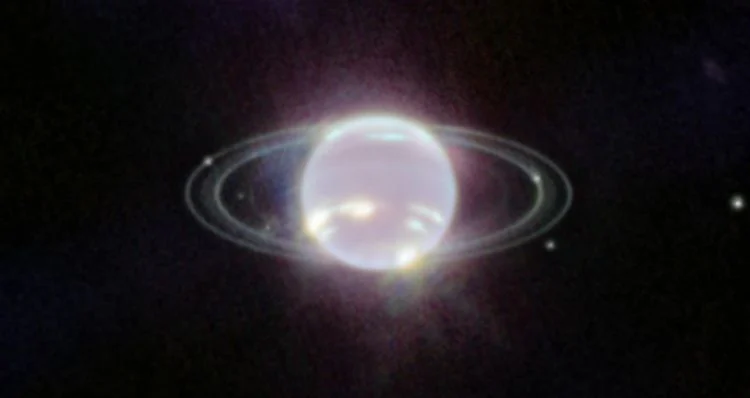
Neptune's largest moon is actually an intruder that destroyed everything in its path? Scientists now believe that the rings and small moons you see around the eighth planet are the frozen remains of much larger worlds - these original satellites were ripped to pieces billions of years ago when a giant object from the edge of the solar system crashed into the neighborhood.

Triton is the moon responsible for this ancient mess - It is so huge that it makes up more than 99.5 percent of all the mass orbiting Neptune. Because it travels in the opposite direction of the planet's rotation, researchers are sure it is a captured object from the Kuiper Belt. When Triton entered orbit, its gravity pulled and pushed on the original moons, causing them to collide and shatter into dust and rubble.

The Arrival of Triton and a System in Chaos

Before Triton arrived, Neptune likely had a neat, orderly system of moons. You can imagine it looking similar to the moons of Uranus today. Triton's capture turned the area into a cosmic demolition zone. The gravitational shifts were so intense that the original moons could not survive in their old paths.

Fragments from these broken worlds eventually spread out into a disk of debris. Over millions of years, some of this material began to stick together again - this process is how the small moons we see today, like Proteus besides Galatea, were born. They are not the original inhabitants but rather the recycled parts of lost worlds.

Surprising Clues from the James Webb Space Telescope

A team from the California Institute of Technology recently used the James Webb Space Telescope to look closely at these moons. They used an instrument called the Near Infrared Spectrograph to see what the surfaces are made of. The results were not what they expected for objects so far from the Sun's heat.

Usually, objects in the outer solar system are covered in water ice. The data shows that Proteus, Larissa, & Galatea are missing this ice - this discovery suggests that the moons are not just simple rocks that formed on their own. They are pieces of the deep interiors of much larger, older moons that lost their outer layers during the chaos.

Clay Minerals and the Absence of Ice

The researchers found something even more specific on the moons Larissa or Galatea - these bodies contain clay minerals that are rich in water and magnesium - these types of minerals usually form when water interacts with rock over a long time - this is a big clue that the material was once deep inside a planet sized body where it was warm enough for liquid water to exist.

  • Larissa
    Contains water rich clay minerals with magnesium.
  • Galatea
    Also shows signs of these specific magnesium clays.
  • Proteus
    Does not have these clays, suggesting it formed from a different part of the debris cloud.

Because Proteus is different, the team thinks the debris disk was not the same everywhere. Different layers of the old moons ended up in different places - this helps explain why some moons have certain minerals while their neighbors do not.

How Today's Moons & Rings Reassembled

The rings of Neptune are very dark and dusty - For a long time, their origin was a mystery to astronomers. It seems clear that the rings are simply the bits of the old moons that never quite managed to clump back together into a full moon. They are the "crumbs" left over from the giant collision event caused by Triton.

The moons we see today are much smaller than the ones that came before - those are the sizes for the moons studied by the Caltech team

  • Triton
    2 705 kilometers (1 681 miles) wide.
  • Proteus
    420 kilometers (261 miles) wide.
  • Larissa
    194 kilometers (120 miles) wide.
  • Galatea
    175 kilometers (109 miles) wide.

A Brief History of Neptune's Growing Family

Neptune was first seen in 1846, & Triton was found just one month later. It took a very long time to find the rest of the family because Neptune is so far away. It was more than a century before the next moon, Nereid, was spotted in 1949. Many of our knowledge comes from a single visit by a spacecraft.

NASA's Voyager 2 flew past the planet in 1989 and found six new moons. Since then, better telescopes have helped us find even more. In 2002 and 2003, astronomers found multiple small moons with very wide orbits. The most recent discovery happened in 2021, bringing the total number of known moons to 16. Each of the small worlds carries a piece of the history of that ancient, violent collision.

FAQ

Why doesn't Neptune have its original moons?

Many of the original moons were destroyed when Triton was captured. Triton's gravity was so strong that it forced the older moons to crash into each other, turning them into a disk of rubble.

Are Neptune's rings made of ice?

No, latest data shows the rings and inner moons lack water ice. They are likely made of rocky material and clay minerals that came from the inside of larger, shattered moons.

Is Triton going to stay at Neptune forever?

Triton is actually slowly moving closer to Neptune - Eventually, billions of years from now, it will get so close that Neptune's gravity will tear it apart, creating a massive new ring system around the planet.

How do scientists know what these moons are made of?

They use the James Webb Space Telescope to study the light reflecting off the moons. By looking at the "fingerprints" in the infrared spectrum, they can tell which minerals are present on the surface.

References

  1. Caltech News - "Neptune's Inner Moons May Be Shattered Remains of Ancient Icy Worlds" - https://www.caltech.edu/about/news/neptunes-inner-moons-may-be-shattered-remains-of-ancient-icy-worlds

  2. NASA Science - "Neptune Moons" - https://science.nasa.gov/neptune/moons

  3. Wikipedia - "Moons of Neptune" - https://en.wikipedia.org/wiki/Moons_of_Neptune

  4. Go-Astronomy - "Moons of Neptune" - https://www.go-astronomy.com/moons-of-neptune.htm

  5. Science Advances - Research paper by Ryleigh Davis et al. (2026) - https://www.science.org/doi/10.1126/sciadv.aeb1437

  6. Universe Today - "Smashed Ice Worlds Formed Neptune's Inner Moons and Rings" - https://renfrewshireastro.co.uk/smashed-ice-worlds-formed-neptunes-inner-moons-and-rings

  7. NASA - "Neptune: Facts" - https://science.nasa.gov/neptune/neptune-facts

J

Jonathan Bala

Contributing writer for ALLTHINGSGEO.

Related Articles