
How Solar Wind Strips Atmospheric Gas From Dead Planets
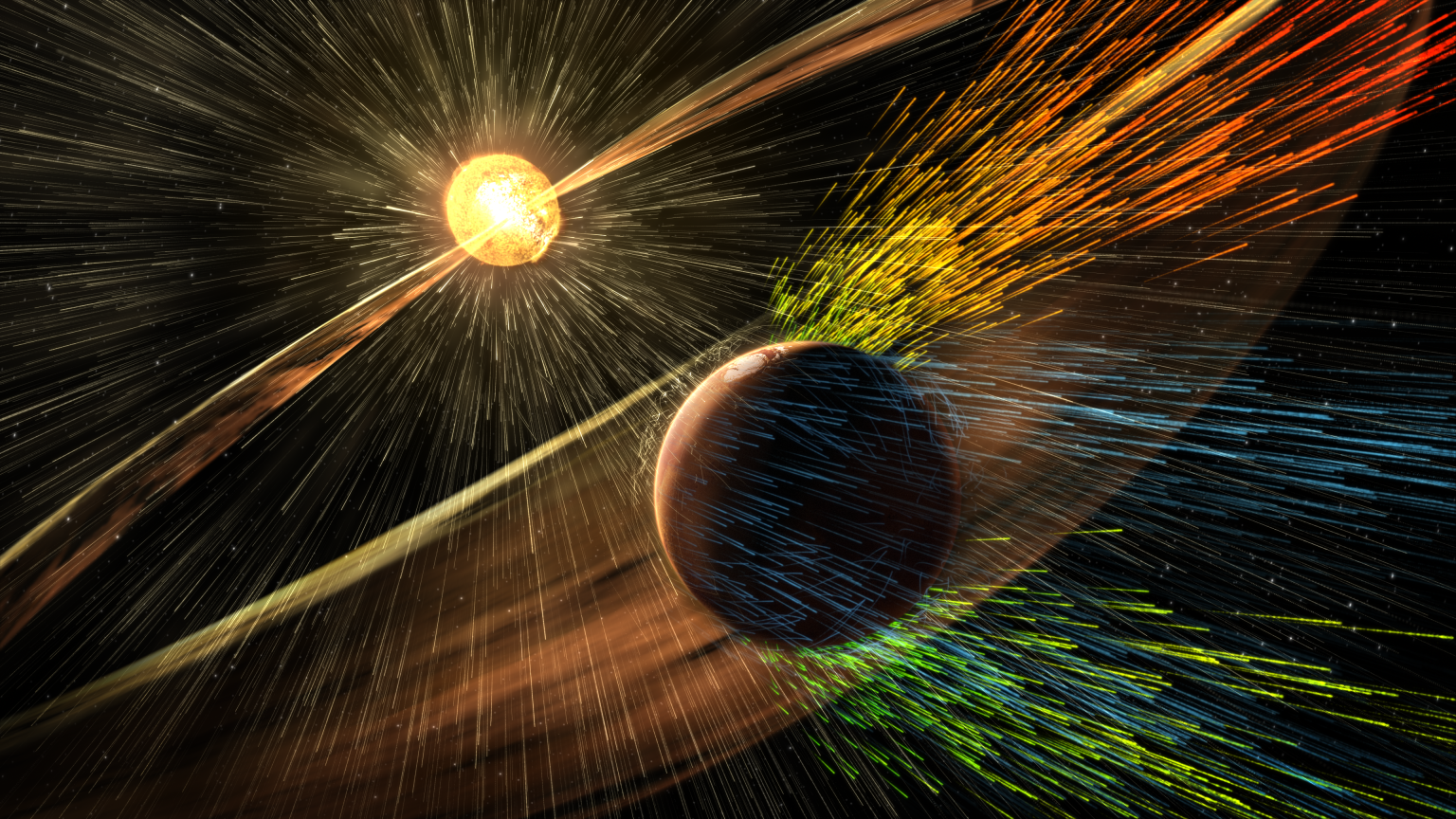
A planet does not need a massive explosion to lose its atmosphere. Over billions of years, charged particles from its star can remove atmospheric gas little by little. Mars is the clearest example in our solar system. NASA’s MAVEN mission showed that solar wind and radiation have driven major atmospheric loss on Mars, helping change it from a wetter world in the distant past into the cold, dry planet we see today. Research published in 2025 and 2026 has added direct evidence of sputtering and new details about how Mars responds to strong solar activity.
What Is Solar Wind?
The solar wind is a continuous flow of electrically charged particles released by the Sun. It contains mostly protons and electrons and carries the Sun’s magnetic field through space. The stream reaches planets across the solar system, while atmospheres and magnetic fields can reduce its impact.
Earth has a strong global magnetic field that helps push much of the solar wind around the planet. Mars does not have a global field generated by an active core; instead, it has an induced magnetic environment created when solar wind meets its upper atmosphere.

How Does Solar Wind Remove Atmospheric Gas?
The solar wind does not simply blow a planet’s air away. Several connected processes are involved.
Ultraviolet radiation can ionize atoms and molecules high in the atmosphere. Once particles become electrically charged, they can interact strongly with the magnetic field carried by the solar wind.
At Mars, these interactions create fields that transfer energy from the solar wind to atmospheric ions. Some ions accelerate to high speeds and escape into space. MAVEN observed escaping ions, including in the long downstream “tail” formed by the solar wind. NASA found that most of the escaping ions observed by MAVEN came from this tail region, with another major source coming from a polar plume.
Another process is sputtering. Energetic ions collide with atmospheric particles and knock them out of the atmosphere. In May 2025, scientists using more than nine years of MAVEN data reported the first direct observations of present-day atmospheric sputtering at Mars. They found sputtered argon rates more than four times higher than some earlier model predictions and evidence that solar storms can increase the process.
Why Magnetic Fields Matter
A magnetic field can reduce a planet’s direct exposure to the solar wind, but it does not guarantee that an atmosphere will survive forever.
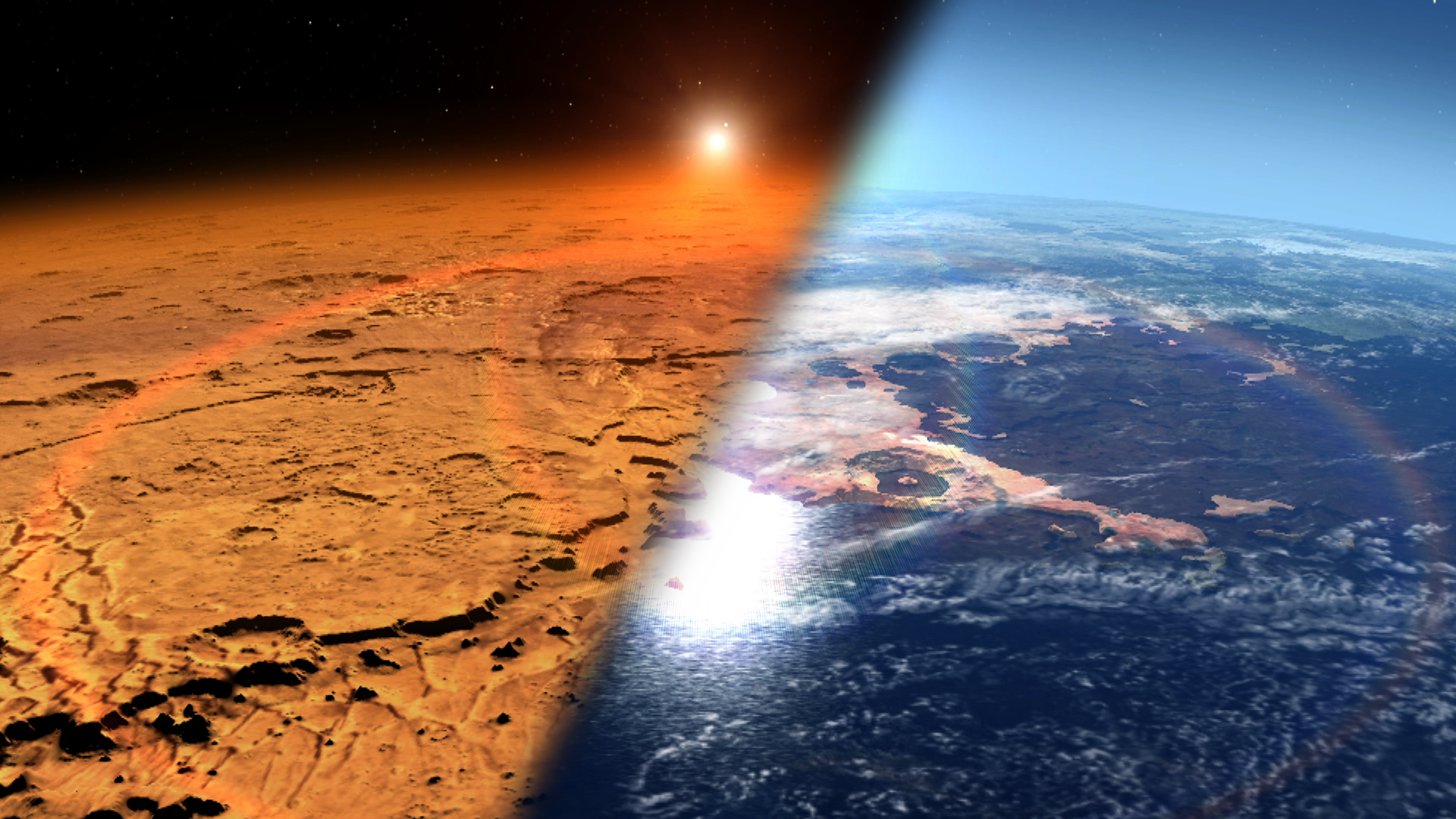
Mars appears to have lost its global magnetic field early in its history. After that, its upper atmosphere became more directly exposed to the solar wind and solar storms. NASA says this helped atmospheric erosion continue over billions of years.
The young Sun also matters. Early in the solar system’s history, the Sun was more active, producing stronger solar wind and higher ultraviolet radiation. Mars therefore likely experienced much stronger atmospheric erosion in the past than it does today.
NASA’s MAVEN measurements showed a present-day loss rate of about 100 grams of atmosphere per second through solar-wind-driven stripping. That sounds small, but continuous loss over geological time can become significant.
What Happened to Mars?
Evidence from Martian rocks, landforms, minerals and atmospheric measurements shows that Mars had a wetter environment billions of years ago, when liquid water could exist at the surface.
As the atmosphere became thinner, Mars could no longer maintain the same surface conditions. Lower pressure made stable liquid water much harder to maintain, while the planet also became colder and drier.
Atmospheric escape is only part of the story. Some gases become locked into rocks, while others escape through photochemical and thermal processes. The solar wind is one part of a larger system controlling planetary climates.
What MAVEN Taught Scientists
NASA ended the MAVEN mission on June 3, 2026, after losing contact with the spacecraft in December 2025. The mission had spent more than 11 years studying the Martian upper atmosphere, ionosphere and interactions with the Sun.
A Nature Communications study published in May 2026 reported comprehensive observations of the Zwan-Wolf effect in Mars’ ionosphere. During a strong space-weather event in December 2023, magnetic structures squeezed Martian plasma and changed how the solar wind interacted with the upper atmosphere.
NASA also reported in July 2026 that MAVEN observations improved scientists’ understanding of auroras at Mars. These results show that the Martian ionosphere is more dynamic than its lack of a global magnetic field might suggest.
What Comes Next?
NASA’s ESCAPADE mission is designed to continue studying the solar wind–Mars connection. Its two spacecraft launched in November 2025 and are currently following an Earth-proximity trajectory. NASA says they are scheduled to use an Earth gravity assist in November 2026 and arrive at Mars in September 2027.
ESCAPADE will measure the solar wind, Mars’ hybrid magnetosphere and the upper atmosphere. Scientists hope the mission will show in greater detail how energy moves through the system and drives atmospheric escape.
Could Other Planets Lose Their Atmospheres?
Yes. Atmospheric escape is important in exoplanet research. A planet’s ability to keep an atmosphere depends on gravity, temperature, composition, distance from its star, high-energy radiation and magnetic environment.
Planets around active stars can receive powerful ultraviolet and X-ray radiation as well as strong stellar winds. NASA’s Hubble observations of evaporating exoplanets have shown that intense stellar activity can make atmospheric gases stream away into space. In some cases, the remaining rocky core may eventually look very different from the original planet.
Mars is therefore a nearby laboratory for understanding how planetary atmospheres evolve and change climate.

The Bigger Picture
Atmospheric loss is a story about time. A planet can lose only a small amount of gas at a time, yet the effect can become enormous after billions of years.
Mars shows that an atmosphere is not permanent. Solar wind, ultraviolet radiation, magnetic fields, chemistry and gravity work together to determine whether a planet keeps its protective layer of gas or gradually loses it to space.
“Dead planet” is an informal phrase, because Mars is not literally dead and is still being studied. Its thin atmosphere and ancient surface record give scientists a chance to understand what happens when a rocky world loses much of the gas that once helped support a wetter climate.
As ESCAPADE prepares for its Mars encounter, researchers will have another opportunity to study the solar wind–atmosphere relationship and learn how stars can slowly rewrite the history of planets.
Frequently Asked Questions
What is solar wind?
Solar wind is a continuous stream of charged particles, mainly protons and electrons, released by the Sun.
How does solar wind strip a planet’s atmosphere?
It can transfer energy to atmospheric ions, accelerate charged particles into space and drive processes such as ion escape and sputtering.
Why did Mars lose so much atmosphere?
The loss involved solar wind, ultraviolet radiation and other atmospheric escape processes over billions of years. Mars’ lack of a global magnetic field made its upper atmosphere more exposed.
Did Mars once have liquid water?
Yes. Multiple lines of geological and atmospheric evidence show that Mars had wetter conditions and surface environments where liquid water existed in its ancient past.
What is atmospheric sputtering?
Sputtering happens when energetic particles collide with atmospheric material and knock atoms or molecules out into space.
What happened to NASA’s MAVEN mission?
NASA declared MAVEN’s mission ended on June 3, 2026, after the spacecraft became unrecoverable following a loss of contact in December 2025.
What is ESCAPADE?
ESCAPADE is a NASA mission with two spacecraft designed to study how the solar wind interacts with Mars and contributes to atmospheric escape.
Can exoplanets lose their atmospheres too?
Yes. Observations show that strong radiation and stellar activity can cause atmospheric gases to escape from planets orbiting other stars.
Will Mars ever completely lose its atmosphere?
Atmospheric escape is ongoing, but the exact long-term future depends on many physical processes and timescales. Current evidence does not support a simple date for complete atmospheric loss.
References
NASA — MAVEN Reveals Most of Mars’ Atmosphere Was Lost to Space
NASA — Mission Reveals Speed of Solar Wind Stripping Martian Atmosphere
NASA Science — First Observation of Atmospheric Sputtering at Mars
Nature Communications — Detection of Zwan-Wolf Effect in the Ionosphere of Mars
NASA — MAVEN Mission Ends After More Than 11 Years